Free · Singapore
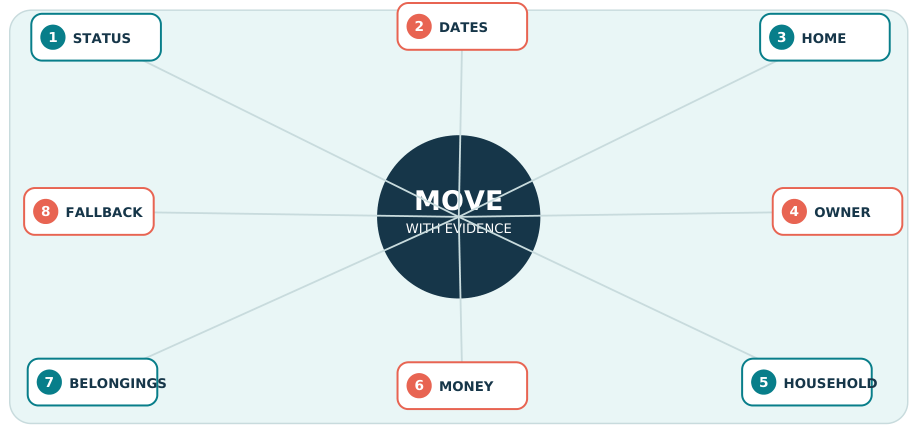
Eight Decisions Before Moving to Singapore
A free pre-move guide for finding the assumptions that can derail your plan
Moving plans often look complete because they contain a flight, a start date and a place to stay. Those three details do not prove that the move works.
The hidden risks are usually dependencies: a job that assumes a pass is issued, a lease that assumes the tenant is eligible, a shipment that assumes tax relief, or a family plan that assumes everyone may arrive on the same date. This guide helps you expose those dependencies before you spend heavily or give up an option at home.
It is not an immigration, employment, tax or legal service. It does not predict an approval. It gives you eight decisions to make, a way to label what is still uncertain, and a one-page record you can take to the employer, school, landlord or relevant authority.
The useful outcome: by the end, you will have eight written decisions, an evidence list and a stop/go rule for your move.
Start here: use four labels, not “sorted”
For every decision, mark one of these four states.
| State | What it means | What counts as evidence |
|---|---|---|
| Confirmed | The responsible party or authority has given you the specific answer you need. | Approval notice, official status result, signed agreement, dated written confirmation or published rule that clearly applies to your case. |
| Conditional | The answer is known only if another event happens first. | “Employer will file after contract signature”; “landlord will proceed after pass eligibility check.” |
| Unconfirmed | You have a plan, but no reliable evidence yet. | A verbal assurance, forum post, old screenshot, agent estimate or your own assumption. |
| Not applicable | You checked the issue and can explain why it does not apply. | A short reason plus the official or contractual basis where relevant. |
Do not use probably, usually or my friend did it as a fifth state.
The dependency rule
When Decision B cannot be completed until Decision A is confirmed, write the dependency plainly:
“I will not make the non-refundable housing payment until the pass route and tenant eligibility have been checked for the named occupants.”
That sentence is more useful than a longer checklist with no stop rule.
Decision 1 — What gives each person the right to stay?
The question
On the intended arrival date, what immigration status or pass will each person rely on, who controls the application, and what remains to be completed?
Do not collapse a visa, permission to enter, a visit pass, a work pass, a Student’s Pass and a Long-Term Visit Pass into one idea called “the visa.” They do different jobs.
Singapore’s Immigration & Checkpoints Authority (ICA) publishes routes for residence, visits and Student’s Passes. The Ministry of Manpower (MOM) publishes work-pass routes, including training-related work passes. A short-term visit pass is for an eligible short visit; ICA states that its holder must not work, paid or unpaid, unless a valid work pass or a specific work-pass exemption applies. A valid entry visa, where required, is not itself an immigration pass and does not guarantee entry.
Write this for every traveller
| Person | Intended status on arrival | Application owner | Current evidence | Missing step | Latest safe arrival date |
|---|---|---|---|---|---|
| You | |||||
| Adult 2 | |||||
| Child/dependant |
Ask the responsible party
- What is the exact pass or status name?
- Who submits the application: you, an employer, a school, a sponsor or someone else?
- Is there an in-principle approval, issuance step, registration, medical examination or other post-approval formality?
- Does the document allow the activity you intend to do?
- What happens if the planned start date arrives before the pass is issued?
- May accompanying family members apply at the same time, or only after another event?
Stop rule
Do not describe the move as legally ready while any person’s intended status is only a hope, or while the status does not cover the intended activity.
Official starting points: ICA — Reside, Study and Work, MOM — Work passes and permits, ICA — Extension and conditions of a Short-Term Visit Pass.
Decision 2 — Which date is real: travel, pass, work or school?
The question
Which event actually controls your move, and how much flexibility exists if another event slips?
A flight date is not automatically the legal start date, employment start date, school start date, lease start date or shipment date. Put them on one line before you book around them.
Build the date chain
| Event | Target date | Earliest possible | Latest tolerable | Who can move it? | Evidence |
|---|---|---|---|---|---|
| Pass application submitted | |||||
| Decision or status update expected | |||||
| Entry permitted / formalities | |||||
| Employment or course begins | |||||
| Temporary lodging begins | |||||
| Long-term tenancy begins | |||||
| Household shipment released | |||||
| Current-home commitment ends |
Draw an arrow only where one date truly depends on another. Do not invent a processing promise. Use the current official service page or the named case owner for the applicable route.
The three-date test
Before paying a change fee or penalty, identify:
- Commit date — when money or rights become hard to recover.
- Evidence date — when you expect the missing evidence.
- Fallback date — the last date on which Plan B still works.
If the commit date comes before the evidence date, you are choosing to carry that risk. Write the maximum amount you are prepared to lose; do not leave it implicit.
Stop rule
Do not make one irreversible date depend on an authority, employer, school or landlord meeting an unofficial estimate.
Decision 3 — Where will you sleep first, and when can housing become long-term?
The question
What lawful accommodation covers the first nights, and what must be confirmed before you sign a longer tenancy?
Separate landing accommodation from long-term housing. This removes pressure to sign an unsuitable lease from abroad.
For private residential property, the Urban Redevelopment Authority (URA) states that occupants must meet a minimum stay of three consecutive months; daily or weekly use of private homes as short-term accommodation is not allowed. Lawful hotels and qualifying serviced apartments are different accommodation types. HDB rentals have their own tenant eligibility, approval, occupancy and non-citizen-quota rules. These are reasons to verify the exact property and every named occupant, not reasons to guess from an advertisement.
Landing accommodation record
| Item | Your answer |
|---|---|
| Property type and full address | |
| Check-in and check-out dates | |
| Booking holder and occupants | |
| Cancellation deadline and amount at risk | |
| Late-arrival instruction | |
| Who verified that this is a lawful accommodation type? | |
| Backup for the first night |
Long-term housing questions
- Is the property HDB, private residential, serviced apartment or another lawful type?
- Are all intended tenants eligible for that exact arrangement?
- Has the owner or authorised representative been verified?
- Are the minimum stay and occupancy rules compatible with your plan?
- What depends on a pass, employer letter or arrival formalities?
- What is due before signing, at signing and at handover?
- Who handles urgent repairs after handover? An estate agent’s transaction role may not include ongoing property management.
The Council for Estate Agencies (CEA) provides tenant checklists and tenancy agreement templates for HDB and private residential rentals. Use the template that matches the property; do not treat a room agreement as permission to occupy an entire flat.
Stop rule
Do not pay merely because someone creates urgency. Verify the property, the person’s authority, your eligibility and the written terms first.
Official starting points: URA — Renting Property, URA — Short-Term Accommodation, CEA — private-residential rental guide, checklist and template, CEA — HDB tenant guide and checklist.
Decision 4 — What must your employer or school answer in writing?
The question
Which parts of the move are owned by the employer or school, and which are yours?
“Relocation support included” is not a usable answer. Convert it into named deliverables, owners and dates.
Employer questions
- Exact work-pass route and who submits it.
- Documents you must supply and the deadline.
- Whether the proposed start date changes if issuance or formalities are incomplete.
- Who arranges or pays for required medical checks, insurance, temporary lodging, shipment or flights, if any.
- Whether family-pass support is included and what “support” means.
- Which expenses are reimbursed, the currency limit, receipt rules and claim deadline.
- What happens to relocation costs if employment does not begin or ends early.
MOM’s application pages show that responsibilities vary by pass. For example, many employer-sponsored routes require action by the employer or its authorised agent. The route must be checked by exact name; a general promise that “HR handles visas” is insufficient.
School questions
- Exact admission status and any conditions still outstanding.
- Whether a Student’s Pass is required for the course and who initiates the process.
- Which dates require physical presence.
- What happens if pass formalities are not complete by the course start.
- Dependant, guardian or parent arrangements, where relevant.
- Refund, deferral and withdrawal rules.
ICA states that a foreigner accepted into an approved full-time course generally needs a Student’s Pass unless a stated exception applies. Part-time, evening and weekend courses do not qualify for a Student’s Pass simply because they are courses.
Responsibility table
| Deliverable | Owner | Due date | Evidence expected | Escalation contact |
|---|---|---|---|---|
| Pass filing | ||||
| Admission/employment condition | ||||
| Family documents | ||||
| Arrival instruction | ||||
| Reimbursement |
Stop rule
If nobody is named as the owner, treat the task as unowned—not completed.
Official starting points: MOM — Work passes and permits, ICA — Student’s Pass.
Decision 5 — Who moves when, and what happens if the household must split?
The question
Will everyone travel together, or is the plan workable if one person arrives earlier?
Household moves fail when the plan assumes that every pass, school place, pet movement, lease and shipment will align on one day.
Choose a deliberate pattern
| Pattern | Best when | Main risk to solve |
|---|---|---|
| Together | Every person has usable status, suitable accommodation and an aligned start date. | One delay disrupts the entire household. |
| Lead mover first | One adult can lawfully enter, start formalities and verify housing before others travel. | Duplicate accommodation, caregiving and travel costs. |
| Staged by need | School, work, pet or medical timing differs by person. | Longer separation and more handovers. |
| Delay the move | A critical legal, financial or care dependency is unresolved. | Lost time, but often lower irreversible cost. |
Household handover card
Record for each person:
- passport and intended status;
- travel date and meeting plan;
- medication and care needs;
- school or work start condition;
- access to money and a working phone;
- copies of key confirmations;
- who can act if the lead mover is unreachable;
- the last date on which the current arrangement remains safe.
For pets, controlled items or special medical supplies, do not improvise from a general moving checklist. Use the responsible Singapore authority and carrier for that specific item.
Stop rule
No one should arrive into a plan where their lawful stay, first-night accommodation, essential medication or access to funds depends on another traveller landing on time.
Decision 6 — What can you afford before normal life works?
The question
How much accessible money is needed for the move, the first month and a delay?
This is not a cost-of-living estimate. It is a liquidity test: whether you can pay the right expense at the right time without relying on a bank account, reimbursement or salary that is not yet available.
Build three pots
| Pot | Include | Your amount and currency |
|---|---|---|
| Before travel | Applications, documents, flights, lawful first lodging, shipment deposits, current-home exit costs. | |
| Landing | Local transport, food, temporary connectivity, lodging balance, housing search, deposits only after verification. | |
| Delay reserve | Extra lodging, changed travel, delayed salary or reimbursement, emergency return or household split. |
Apply the access test
For each pot, ask:
- Is the money accessible before a Singapore account exists?
- Can a second adult reach it independently?
- What are the card, transfer and cash limits?
- Which costs are refundable, reimbursable or neither?
- Is the employer reimbursement paid before or after you spend?
- What exchange-rate movement can the plan tolerate?
Do not use the full credit limit as the reserve if losing the card would remove all access. Keep a second method separate.
Stop rule
Do not count a future salary, deposit refund or employer reimbursement as money available today.
Decision 7 — What crosses the border, what waits, and what stays behind?
The question
Which belongings must travel with you, which may be shipped later, and which should not move until the plan is stable?
Shipping everything early feels decisive but can lock money and timing to an uncertain move.
Singapore Customs has a dedicated moving-to-Singapore route for household articles, personal effects, pets and vehicles. Used household items are not automatically tax-free: GST applies unless relief is granted. Eligibility and procedure depend on the item, ownership period, transfer of residence, timing and whether the goods are accompanied or unaccompanied. Customs states that relief is assessed case by case.
Sort belongings into four lanes
| Lane | Meaning | Examples to decide yourself |
|---|---|---|
| Carry | Needed during the first week and lawful to bring. | Documents, essential medication, work or study equipment, basic clothing. |
| Send after trigger | Ship only after a named condition is confirmed. | Larger household goods after long-term housing and import requirements are clear. |
| Store | Keep an option open while the move proves stable. | Sentimental or hard-to-replace items not needed immediately. |
| Dispose/transfer | Do not move it. | Items unsuitable for the new home, prohibited/restricted goods or uneconomic freight. |
Shipment trigger record
Release the shipment only after: ________________________________
Evidence required: _______________________________________________
Person authorised to release it: _________________________________
Maximum delay or storage cost accepted: ___________________________
Stop rule
Do not let a freight schedule decide your immigration, housing or family timeline.
Official starting points: Singapore Customs — Moving to Singapore, Bringing used household items and personal effects.
Decision 8 — What is your pause, fallback and exit plan?
The question
Which event makes you pause, which alternative will you use, and how will you avoid losing every option at once?
A fallback is not pessimism. It is a controlled response decided before urgency and sunk cost distort the choice.
Pick your red lines
Complete at least one sentence in each group.
Legal/status
- We pause if __________________________________ is not confirmed by __________________.
Housing
- We use temporary accommodation rather than sign if ________________________________.
Employment/study
- We ask for a new date or withdraw if ______________________________________________.
Money
- We stop committing new funds when the unrecoverable total reaches __________________.
Household wellbeing
- We stage or delay travel if ________________________________________________________.
Preserve one option
Until the critical evidence exists, consider preserving at least one of these:
- a cancellable or changeable booking;
- access to the current home or a temporary alternative;
- a return-travel reserve;
- storage instead of irreversible disposal;
- continued medication supply and care contact;
- a written employer or school deferral route;
- a person outside the moving household who holds key copies and can help.
Stop rule
If the plan has no defined pause condition, every new cost can feel like a reason to continue. Set the condition now.
Worked example — A move that looks ready but is not
Maya has a Singapore job offer starting 1 February. Her spouse plans to arrive with her, and they have found a private apartment advertised for a two-month lease. A mover offers a discount if the shipment leaves next week.
At first, Maya marks the move “sorted.” Using the eight decisions, she finds four gaps:
- HR has said it will “handle the visa,” but has not named the work-pass route, filing date or what happens if issuance is late.
- Her spouse’s intended status and work plans have not been checked separately.
- The advertised two-month private residential stay conflicts with URA’s published minimum stay of three consecutive months for private residential property.
- The long-term home is not confirmed, so the shipment destination and any Customs relief process are premature.
Maya rewrites the plan:
- Confirmed: signed employment contract and employer case owner.
- Conditional: work start and travel date depend on written pass-stage guidance.
- Unconfirmed: spouse’s status, lawful landing accommodation after the first hotel week and long-term tenancy.
- Trigger: shipment will not leave until lawful long-term housing, inventory and the applicable Customs process are confirmed.
- Fallback: a changeable flight and 21 nights of lawful temporary accommodation remain available until the evidence date.
The guide has not approved or rejected her move. It has turned four hidden assumptions into questions owned by named people.
Your eight-decision dashboard
Complete this on one page. Use a second page for evidence links and document references.
| # | Decision | Your decision in one sentence | State | Evidence owner | Next action/date |
|---|---|---|---|---|---|
| 1 | Status for each person | ||||
| 2 | Controlling dates | ||||
| 3 | First and long-term housing | ||||
| 4 | Employer/school responsibilities | ||||
| 5 | Household travel pattern | ||||
| 6 | Accessible move funds | ||||
| 7 | Belongings and shipment trigger | ||||
| 8 | Pause/fallback rule |
Evidence list
| Evidence needed | Source or person | Requested | Received | Where stored | Expiry/recheck date |
|---|---|---|---|---|---|
The final three sentences
- We can commit now because: _________________________________________________
- We will wait before committing to: __________________________________________
- We will pause or change course if: __________________________________________
If you cannot complete those sentences, the next task is not “book more.” It is “obtain the missing evidence.”
A 20-minute review with your household
Use this short meeting before any major payment.
- Read each dashboard row aloud.
- Let the person most affected challenge the state label.
- Replace “we think” with the name of the evidence or owner.
- Mark the first irreversible payment on the date chain.
- Confirm who can access money, documents and contacts independently.
- Read the pause rule aloud.
- Schedule one evidence review date; do not hold a daily anxiety meeting.
For screen-reader users, the table order follows the same eight numbered decisions as the main text. The State field should contain one of the four written labels, not colour alone.
Official-source register
Checked 25 October 2026. Rules, fees, eligibility and digital services can change; use the live official page for the exact person, property and date.
| Topic | Official source | What this guide used |
|---|---|---|
| Residence and Student’s Pass routes | ICA — Reside, Study and Work | Different statuses have different purposes and application routes. |
| Short-term visit conditions | ICA — Seeking Extension of Visit Pass | A short-term visit pass is not general permission to work. |
| Work-pass routes and case checking | MOM — Passes and permits and check work-pass status | Route and responsible applicant vary; verify by exact pass name. |
| Student’s Pass | ICA — Becoming a Student’s Pass Holder | Approved full-time study generally requires the correct status unless a listed exception applies. |
| Private residential rentals | URA — Renting Property | Minimum stay, occupancy and registration boundaries. |
| Short-term accommodation | URA — Short-Term Accommodation | Daily/weekly rental of private residential property is not lawful short-term accommodation. |
| HDB tenant and rental checks | HDB — Renting from the open market | Tenant eligibility and property-specific checks. |
| Private-residential rental checks | CEA — private-residential rental guide | Tenant checklist and tenancy template for this property type. |
| HDB rental checks | CEA — HDB tenant guide | Tenant eligibility reminder and HDB checklist. |
| Household goods and personal effects | Singapore Customs — Moving to Singapore | GST relief is conditional and procedures differ for accompanied and unaccompanied goods. |
Scope boundary
This free guide deliberately does not reproduce a pass application, choose a pass for you, assess legal eligibility, negotiate a tenancy, calculate tax, provide medical advice or promise processing times. It solves one smaller problem completely: finding the decisions and missing evidence that should come before a costly move.
Singapore Plainly is an independent editorial brand and is not a Singapore government agency.